PCI2USB – M.2 USB Expansion Card with Independent USB Controller
Overview
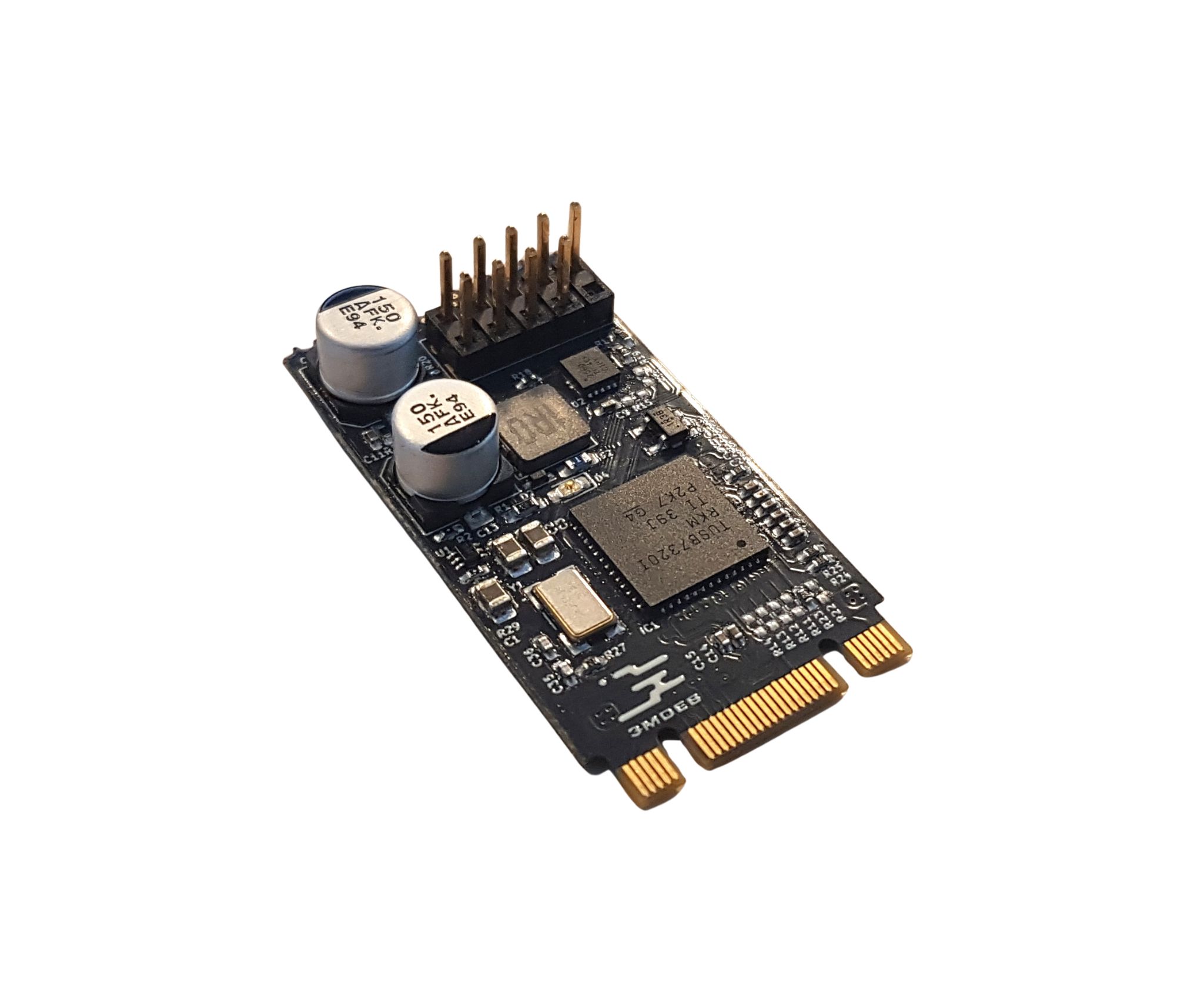
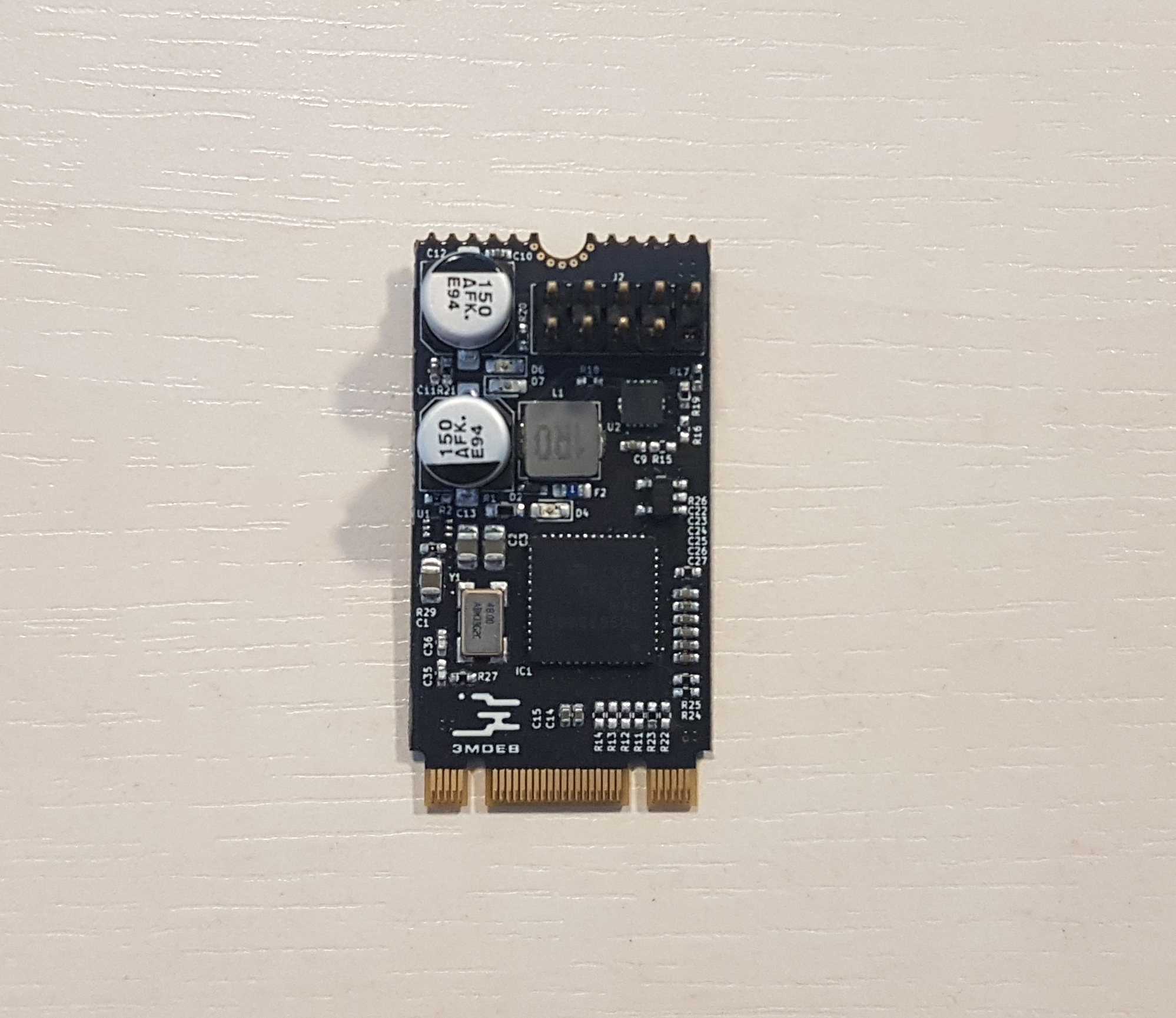
The M.2 USB Expansion Adapter (PCI2USB) is a compact, open-source hardware board compatible with M.2 Key B, Key M, and Key B+M slots, designed to add a dedicated USB controller with two USB ports to systems where internal USB connectivity is limited, unavailable, or where bus isolation is required.
- M.2 adapter compatible with Key B, Key M, and Key B+M slots, adding a dedicated USB controller with two USB ports via PCIe x1 Gen 2
- Powered entirely from the M.2 connector; no additional power cables or adapters needed
- The on-board Texas Instruments TUSB7320 xHCI host controller appears as a fully independent USB controller to the operating system, providing isolation from the system’s existing USB bus
- Provides 2× USB ports via a standard 9-pin internal USB 2.0 header, suitable for keyboards, mice, USB 2.0 flash drives, and other low-power peripherals
- Comprehensive on-board protection circuitry:
- Power section: overvoltage, overcurrent, and supply instability protection
- USB data lines: short circuit and signal integrity protection
- Board supports 2280 form factor with snap-off sections to reduce to 2260 or 2242 – fits compact Mini PCs and embedded platforms with limited M.2 clearance
- Open-source hardware design – KiCad source files and production files available on GitHub
- No driver installation required on modern operating systems with native xHCI support (Linux, Windows, macOS)
Documentation:
Coming soon
Additional information
| Weight | 0,3 kg |
|---|
Description
The M.2 USB Expansion Adapter (PCI2USB) is a compact, open-source hardware board compatible with M.2 Key B, Key M, and Key B+M slots, designed to add a dedicated USB controller with two USB ports to systems where internal USB connectivity is limited, unavailable, or where bus isolation is required.
Unlike simple USB hub adapters, this board adds a fully independent USB host controller to the system, the Texas Instruments TUSB7320 xHCI controller, connected via PCIe x1 Gen 2. This means the two USB ports operate on their own controller, completely separate from the system's existing USB buses. This is particularly valuable in applications where USB bus congestion, latency, or interference between devices is a concern.
The two downstream ports are exposed via a standard 9-pin internal USB 2.0 header, compatible with the vast majority of Mini PCs, embedded platforms, and industrial boards that use this connector type. Since the board is powered entirely from the M.2 connector, the available bus power is suited for low-power USB devices only such as keyboards an mice without backlighting, USB 2.0 flash drives, other similar peripherals.
Integrated protection circuitry safeguards both the host system and connected devices: the power supply section is protected against overvoltage, overcurrent, and supply instability, while the USB data lines are protected against short circuits and signal integrity issues.
A key design feature is the breakable PCB format: the board ships at full 2280 size but includes pre-scored snap lines allowing it to be reduced to 2260 or 2242, enabling installation in compact Mini PCs and embedded systems with physically constrained M.2 slots.
The hardware design is fully open-source, with KiCad source files and production-ready Gerber files published at github.com/3mdeb/PCI2USB
No driver installation is required on Linux (kernel 3.0+), Windows 8 and later, or macOS.